
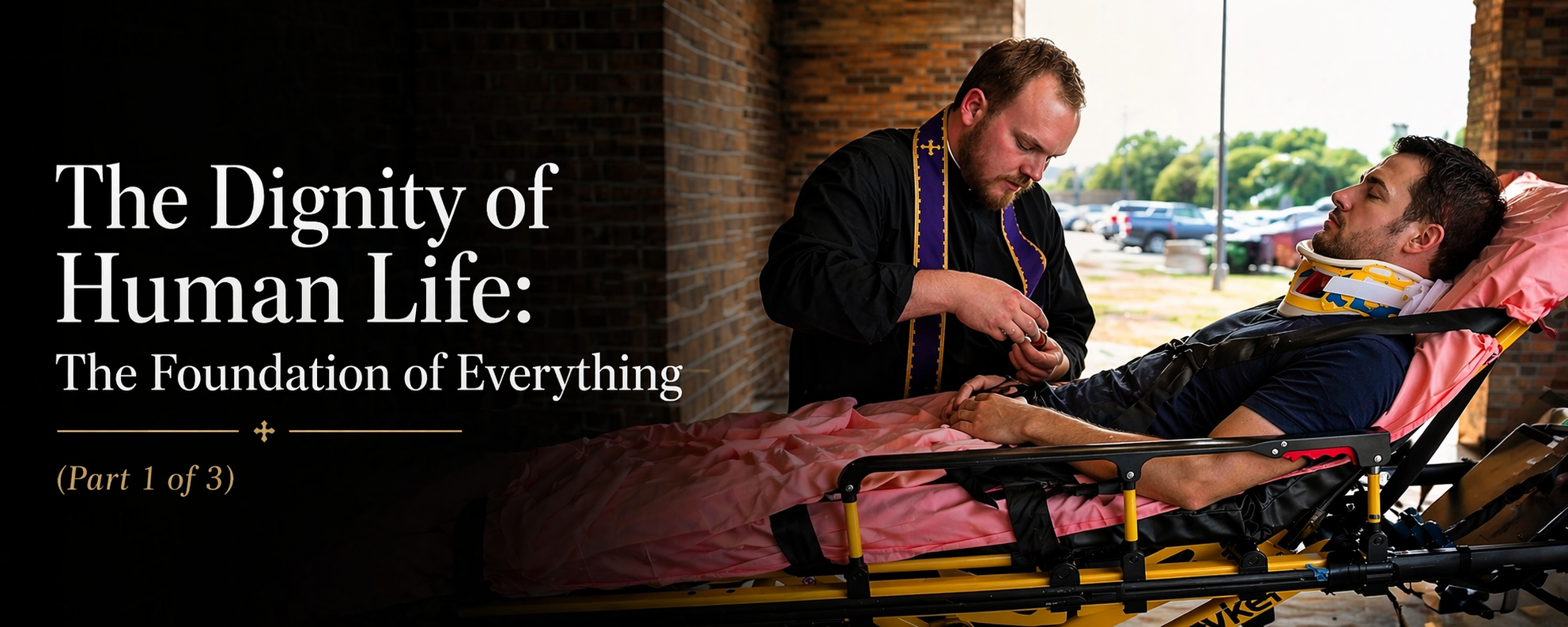
Every serious conversation about politics, justice, or society begins with one question: what is a human life worth?
Before we talk about policies, parties, or candidates, we have to start here: what is a human life worth? If we get that wrong, everything else falls apart. This is not an abstract question. It is the foundation of every moral decision we make, whether we realize it or not.
The Catholic Church does not begin with politics. She begins with truth. And the truth is simple and unchanging: every human person is created in the image and likeness of God. Not because of what they can do, not because of their stage of development, not because of their usefulness, but because God willed them into existence. That means human dignity is not earned. It is given, and because it is given by God, it cannot be taken away by any person, government, or culture. This is where the Church parts ways with much of the modern world. Our culture measures value by productivity, independence, and choice. If someone is dependent, weak, inconvenient, or unwanted, their dignity is quietly questioned. It may not be said outright, but it is reflected in laws, policies, and everyday decisions. The Church rejects that completely. A child in the womb has the same dignity as an adult. The elderly person suffering at the end of life has the same dignity as the healthy and strong. The disabled, the poor, the immigrant, the prisoner all share the same dignity. There are no lesser human beings, no categories of life that are disposable.
This is not sentiment. It is the foundation of moral reasoning. Once you accept that some human lives are less valuable than others, you have already opened the door to injustice. History proves this again and again. Every time a society has redefined who counts as fully human, suffering follows. The language may change, the justification may sound different, but the result is always the same. So the Church draws a clear line: every innocent human life must be protected, always and without exception. That is why the Church speaks so strongly about issues like abortion and euthanasia. Not because she is fixated on a single issue, but because these are direct attacks on human life itself. If we cannot defend life at its most vulnerable, then everything else we claim to care about becomes unstable. A society that permits the killing of the innocent cannot claim to be just, no matter how well it addresses other concerns.
At this point, the objection comes quickly. “What about poverty, war, immigration, healthcare?” These matter. They matter deeply. The Church speaks about them and insists that we take them seriously. But they are not all the same kind of issue. There is a real and necessary distinction between directly taking innocent life and disagreeing about how best to support and protect life. One is always wrong. The other involves prudence, judgment, and legitimate disagreement among faithful people. If we blur that distinction, we lose the ability to think clearly. You cannot build a just society on a foundation that allows the killing of the innocent. Everything else becomes unstable. Programs may change, policies may shift, but without a firm commitment to the dignity of every human life, justice becomes selective and fragile.
This is where the conversation moves from theory to responsibility. If every human life has equal dignity, then that truth must shape not only how we speak, but how we act. It must shape how we evaluate leaders, how we weigh issues, and yes, how we vote. A Catholic cannot separate faith from public life, not because the Church is trying to control politics, but because truth demands consistency. If you believe something is fundamentally wrong, you cannot support it simply because it is politically convenient or socially accepted. That does not mean every decision is simple. It does mean some lines are not negotiable. It means we must be honest about what matters most and refuse to compromise where human life itself is at stake.
We will take that up more directly in the next part of this series. For now, the foundation is clear: human dignity is not up for debate. Everything else flows from that.