
Human Dignity and Moral Truth: What Cannot Be Compromised (Part 2 of 3)
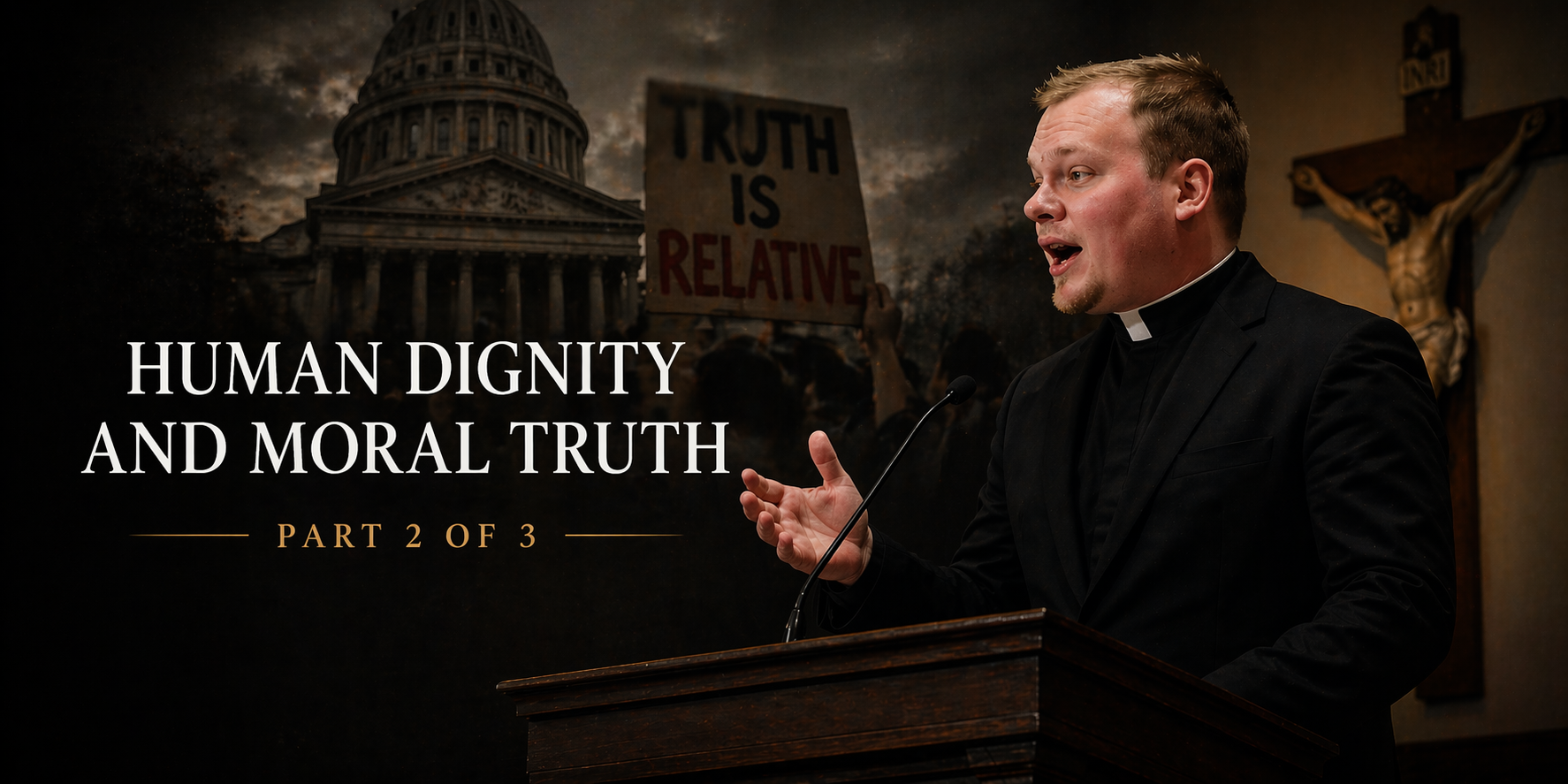
If Part 1 established that every human life has equal dignity, then this follows: some things are simply off limits. Dignity is not a slogan. It draws a line. Cross that line, and you violate the person.
The Catholic Church is clear here. Some actions are always wrong. Not usually wrong. Not wrong depending on circumstances. Always wrong. These are intrinsic evils, acts that are disordered in themselves, regardless of intention, motive, or outcome. You cannot do them for a good reason. You cannot balance them against other goods. You cannot rename them and make them acceptable. This is where many people try to soften the truth. They say, “It’s complicated.” It is not. Complexity applies to strategy and policy. It does not apply to whether an act directly violates the dignity of the human person.
The intentional taking of innocent life is the clearest example. At the beginning of life, this is abortion. At the end, it is euthanasia. In both cases, the act is direct. The object is the same: a human life that is vulnerable, dependent, and unable to defend itself. But it does not stop there. The Church also identifies as intrinsically evil acts like genocide, the targeting of civilians, torture, and the direct destruction of human embryos. These are not gray areas. They are violations of the person at the most basic level. There are also intrinsic evils that attack human dignity in other ways. Rape, human trafficking, slavery, and sexual abuse treat the human person as an object to be used. Perjury and serious deception undermine justice itself. Adultery and pornography distort the meaning of the human body and human love. These are not private matters without consequence. They damage persons and corrode society.
Once you accept exceptions here, dignity becomes conditional. And once dignity is conditional, it is no longer dignity. It is preference. Now, not every issue falls into this category. That matters. Questions about economics, healthcare, or immigration involve real goods, but they do not involve acts that are evil in themselves. There is room for disagreement about how best to pursue justice in these areas. That is not moral weakness. That is the proper use of prudence. But do not blur the distinction. You cannot place a debatable policy choice next to the direct killing of the innocent and pretend they carry the same weight. That is not balance. That is confusion.
This is where the roles of the Church and the State must be stated plainly. The State governs. It enacts laws, maintains order, and pursues the common good. But it does not define what is true. It does not decide what a human person is or what that person is worth. When it tries to do that, it oversteps. The Church does not run the State, but she does something more fundamental. She teaches the truth about the human person. She forms consciences. She names what is good and what is evil. She draws the line the State is not permitted to cross. That is not interference. That is responsibility.
A government that protects life is just. A government that permits the direct destruction of innocent life is not, no matter how it describes itself. You can call it progress. You can call it compassion. But words do not change the nature of the act. At the same time, the Church is not silent about the rest. Care for the poor, the sick, the immigrant, and the marginalized is not optional. It is demanded by human dignity. But how that care is structured in law can vary. That is where judgment is required. That is where good people can disagree.
So here is the line, stated plainly: some actions can never be supported. Others require careful discernment. Both matter, but they are not equal. If that sounds too rigid, consider the alternative. A world where nothing is intrinsically wrong is a world where everything can be justified. And in that world, the weakest always lose. Dignity without moral clarity is empty. It becomes a word we use, not a reality we protect.
Part 3 will take this one step further: how to act when the choices in front of you are imperfect, and how to remain faithful without retreating from the responsibility to decide.