
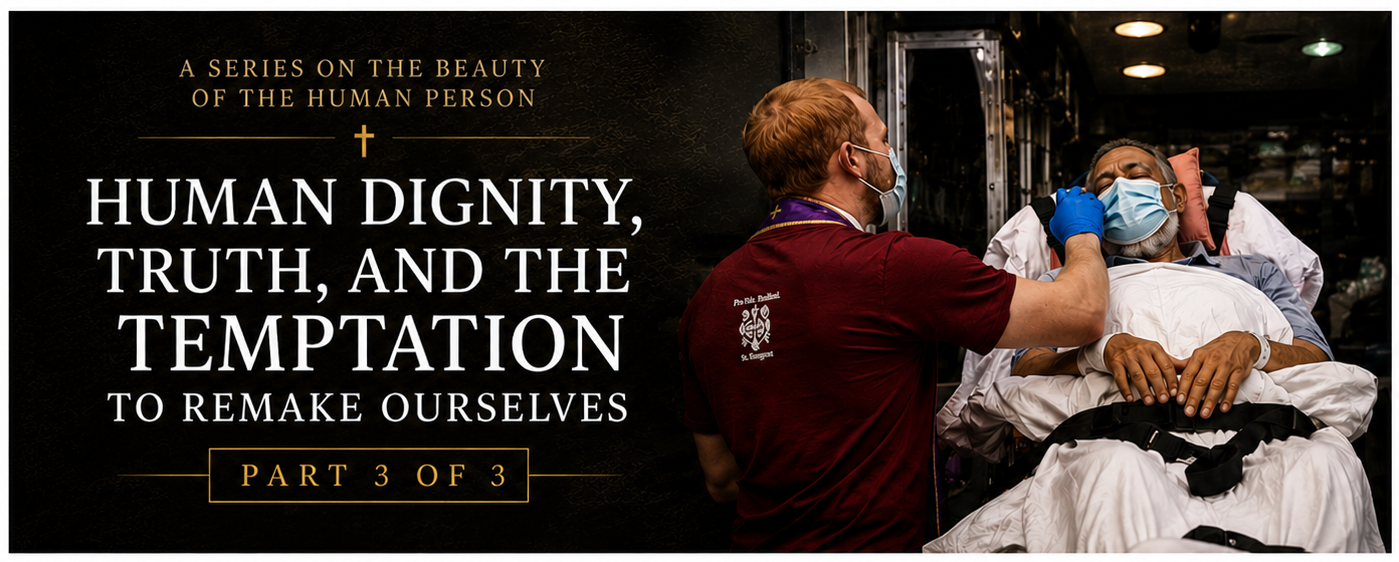
We live in a moment where many people no longer believe that human nature is something received. Instead, it is treated as something invented. The modern world increasingly says that freedom means the ability to define ourselves completely, to determine our own identity, our own meaning, even our own reality. But Christianity says something very different. You are not an accident. You are not self-created. You are not raw material to be endlessly reshaped according to desire, feeling, or social pressure. You were intentionally created by God, and your dignity comes precisely from the fact that you belong to Him.
This is one of the great tensions of our age. We have become very good at speaking about rights, autonomy, and self-expression, but very uncomfortable speaking about truth, limits, sacrifice, and purpose. Yet without truth, freedom collapses into confusion. If there is no created purpose to the human person, then dignity itself becomes unstable. Human value becomes something assigned by society, politics, usefulness, productivity, emotional affirmation, or public approval. The Church refuses to accept that because the Church believes that dignity is not earned, negotiated, voted on, or self-created. It is received from God.
Human identity and human dignity are inseparably connected. The reason every human life has value is because every human being has been created intentionally by God in His image and likeness. Our identity is not first political, emotional, racial, economic, sexual, or ideological. Our deepest identity is that we are sons and daughters created by God and called into communion with Him. That identity is not something we manufacture. It is something we receive. This is why the Church speaks so consistently across many issues. The same belief that causes the Church to defend the unborn child also causes the Church to defend the immigrant, the poor, the elderly, the prisoner, the addicted, the disabled, and the mentally ill. Human dignity is not selective. The Church cannot defend dignity only when it is convenient or socially acceptable. If dignity comes from God, then every human life possesses value even when society no longer sees usefulness in that person.
But we also cannot separate dignity from truth. To love someone does not mean affirming every desire or every self-understanding. Real love desires the good of the other person, even when the truth is difficult. Parents understand this instinctively. A loving parent does not simply allow a child to do whatever he wants. Love forms. Love guides. Love sometimes says no. Christ does the same thing with us. Jesus is infinitely compassionate toward sinners, but He never confuses compassion with permission. He forgives the woman caught in adultery, but He also tells her, “Go, and sin no more.” (John 8:11)
Part of the confusion in modern society is that feelings have become the highest authority. If I feel something strongly enough, many now assume it must therefore be true, good, and deserving of affirmation. But feelings are real without always being reliable. Human beings experience temptation, confusion, anger, fear, loneliness, envy, and disordered desire every day. The Christian life is not about pretending those struggles do not exist. It is about allowing God to transform us through grace rather than allowing our impulses to define us.
That balance is becoming increasingly difficult for modern society to hold. We are often told that if we disagree with someone’s choices, then we must hate them. That is simply false. Christians are called to love every person deeply and sincerely, while also believing that truth exists and that God’s design for the human person is real. The deepest dignity of the human person is not found in self-expression. It is found in communion with God. The goal of life is not self-invention. The goal is holiness.